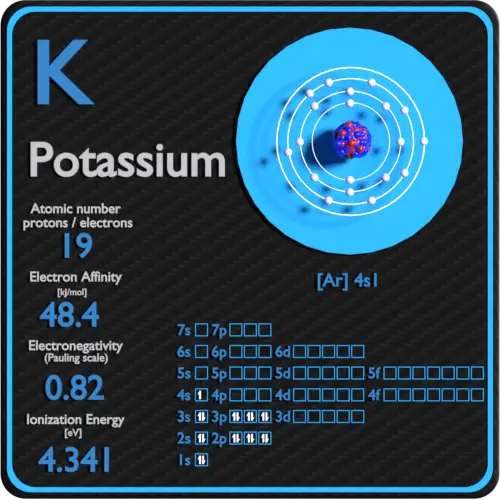
Electronic Configuration Of Potassium. Possible oxidation states are +1. Because of its low first ionization energy of 418.8 kj/mol, the potassium atom is much more likely to lose the last electron and acquire a positive charge, although negatively charged alkalide k − ions are not impossible.
Potassium Periodic Table and Atomic Properties from material-properties.org
The next six electrons will go in the 2p orbital. Potassium has an atomic number of 19 and it contains a total number of 19 electrons. To write an electron configuration you must first determine the.
, And This Configuration Is Precisely The.
The electron configuration of potassium ion (k +) is 1s 2 2s 2 2p 6 3s 2 3p 6. The next six electrons will go in the 2p orbital. Just replace this portion of zinc's electron notation with argon's chemical symbol in.
The Atomic Mass Of Potassium Is 39.098 Atomic Mass Units.
Potassium is an element of the fourth period of the system of elements, therefore it has four electronic levels, each of which contains different types of sublevels. The element has been in use for hundreds of years. In the normal state, the atom of this alkali metal has the following configuration:
Potassium Is A Chemical Element With Atomic Number 19 Which Means There Are 19 Protons And 19 Electrons In The Atomic Structure.the Chemical Symbol For Potassium Is K.
Electron configuration and oxidation states of potassium. For a neutral element there must be 19 electrons, 19 fundamental particles of negative charge. Because of its low first ionization energy of 418.8 kj/mol, the potassium atom is much more likely to lose the last electron and acquire a positive charge, although negatively charged alkalide k − ions are not impossible.
Electronic Configuration Of Potassium Is 2,8,8,1.
The full electron configuration of potassium ( k) is 1s 2 2s 2 2p 6 3s 2 3p 6 4s 1. Potassium is in the 1st group. The first two electrons will go in the 1s orbital.
19 Rows Potassium Was The First Metal Isolated By Electrolysis, The Decomposition Of A Chemical Body Under.
Since 1s can only hold two electrons the next 2 electrons for potassium go in the 2s orbital. And so the ion must have 18 electrons: For example, for potassium (k) (atomic #19), the preceding noble gas is argon (ar) (atomic #18).