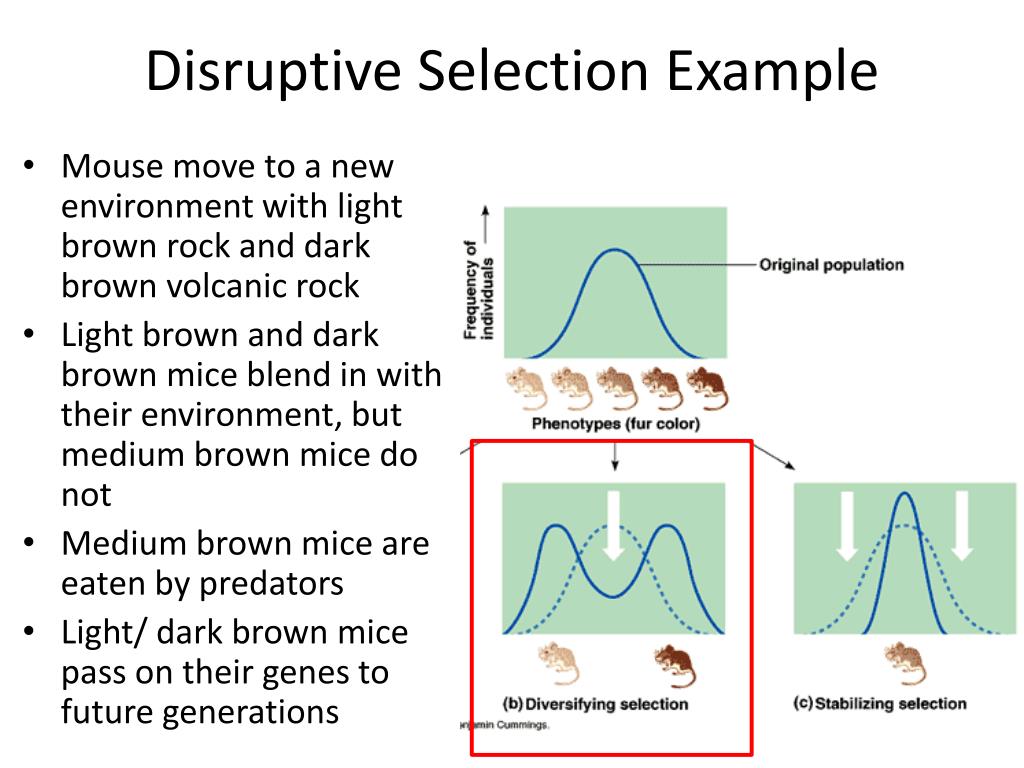
What Is The Definition Of Disruptive Selection. Disruptive selection, also called diversifying selection, describes changes in population genetics in which extreme values for a trait are favored over intermediate values. Disruptive selection the selection in favour of phenotypic extremes in a population.
PPT Types of Natural Selection PowerPoint Presentation from www.slideserve.com
Disruptive or diversifying selection is another type of natural selection mechanism responsible for the selection of extreme phenotypes over intermediate phenotypes. Natural selection is the mechanism of evolution which favors organisms that are better adapted to their environments. A mode of natural selection in which a single phenotype is favored, causing the allele frequency to continuously shift in one direction.
The Disruptive Selection Definition Is Defined As An Evolutionary Force That Drives A Population Apart.
Secondly, disruptive selection is selection for extreme trait values and often results in two different values becoming most common, with selection against the average value. The disruptive selection causes the organisms with intermediate traits in order to reproduce less, and allow those organisms with extreme traits to produce more. D) all or most of the natural variation for these traits has been eliminated.
Disruptive Selection, Also Called Diversifying Selection, Describes Changes In Population Genetics In Which Extreme Values For A Trait Are Favored Over Intermediate Values.
In this case, the variance of the trait increases and the population is divided into two distinct groups. Disruptive selection is when the population has selection pressures acted upon it that selects against the average phenotype and the extreme phenotypes are selected for. Directional selection, stabilizing selection and disruptive selection are three types of natural selection.
C) The Corn Population Has Been Weakened By Artificial Selection.
The makeup of this type of population would show phenotypes (individuals with groups of traits) of both extremes but. For example, in the absence of food necessary for the growing young of perch, that is, the fingerlings of other fish, there may remain only “dwarfs” (individuals with. A mode of natural selection in which a single phenotype is favored, causing the allele frequency to continuously shift in one direction.
Consequently, It Is The Opposite Of.
Disruptive or diversifying selection is another type of natural selection mechanism responsible for the selection of extreme phenotypes over intermediate phenotypes. Disruptive selection, also called diversifying selection, describes changes in population genetics in which extreme values for a trait are favored over intermediate values. Natural selection is the mechanism of evolution which favors organisms that are better adapted to their environments.
When Both Extremes Are Selected For Equally, It's Called Disruptive Selection.
Disruptive selection has garnered much attention among evolutionary biologists and ecologists because of its role in the evolution and maintenance of phenotypic (and genetic) variation and speciation, particularly sympatric speciation. Disruptive selection (diversifying selection) favors the two extreme phenotypes of the trait and minimizes the average phenotype. Disruptive selection disruptive selection is the rarest of these three types of natural selection, but is.