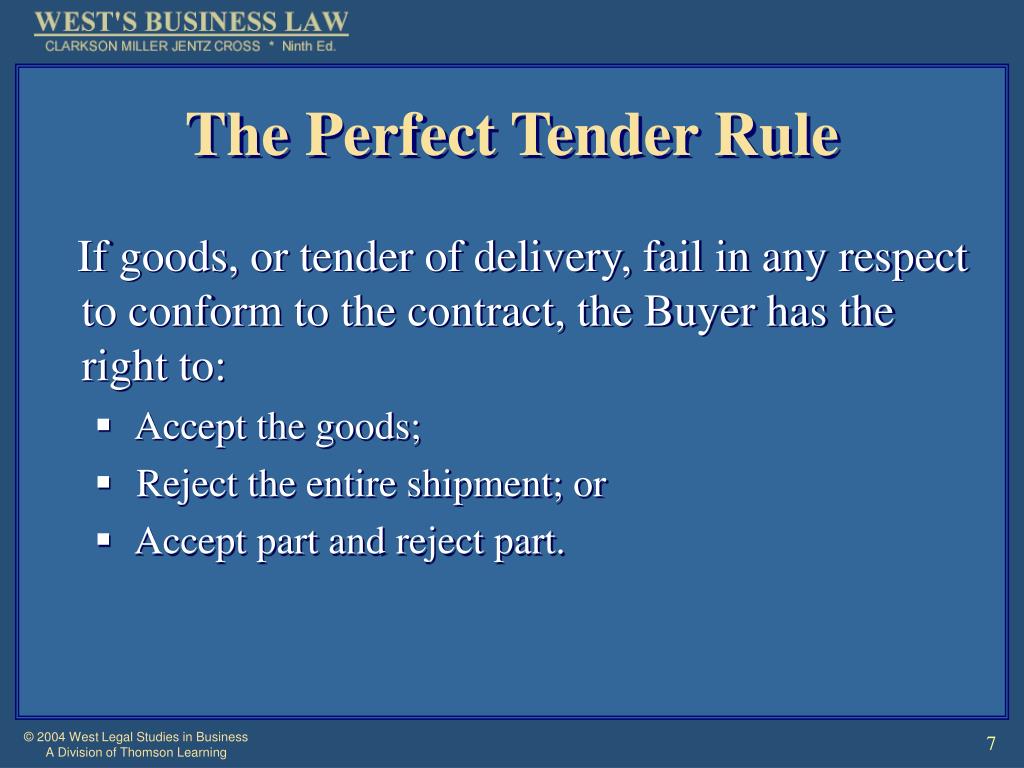
The Perfect Tender Rule. In a contract for the sale of goods, if the goods fail to conform exactly to the description in the contract (whether as to quality, quantity or manner of delivery) the buyer may nonetheless accept the goods, or reject the goods, or reject the. If the goods deviate even slightly from the terms of the contract, then the.
PPT Chapter 21 Performance of Sales and Lease Contracts from www.slideserve.com
Under article 2 of the uniform commercial code, when dealing with the sale of goods, the perfect tender rule states that a buyer is permitted to reject goods shipped or delivered to it from a seller if the seller's tender of the goods is in some way not perfect. Can be used as content for research and analysis. In a contract for the sale of goods, if the goods fail to conform exactly to the description in the contract (whether as to quality, quantity or manner of delivery) the buyer may nonetheless accept the goods, or reject the goods, or reject the.
Beside Above, What Is The Difference Between The Ucc Perfect Tender Rule And The Common.
The perfect tender rule is preserved to the extent of permitting a buyer to reject goods for any defects — ramirez v. Legal definition of perfect tender rule. Perfect tender rule n :
A Rule That Permits A Buyer To Reject Goods If They Or The Tender Of Delivery Fail To Conform To Contract In Any Respect The Perfect Tender Rule Is Preserved To The Extent Of Permitting A Buyer To Reject Goods For Any Defects —.
The perfect tender rule, according to miller and jentz (2005) refers to the responsibility of the seller “to deliver goods in conformity with the terms of the contract in every detail (jentz 2005, p. If the goods fail to conform to the description, the buyer may. Under article 2 of the uniform commercial code, when dealing with the sale of goods, the perfect tender rule states that a buyer is permitted to reject goods shipped or delivered to it from a seller if the seller's tender of the goods is in some way not perfect.
The Perfect Tender Rule Is A Term That Refers To The Legal Right A Buyer To Insist That The Goods Purchased Conform Precisely To The Product Description In Quality, Quantity, And Manner Of Delivery.
Under article 2 of the uniform commercial code, when dealing with the sale of goods, the perfect tender rule states that a buyer is permitted to reject goods shipped or delivered to it from a seller if the seller's tender of the goods is in some way not perfect. If the tender is perfect, then the buyer has an obligation to pay the purchase price. Collected from the entire web and summarized to include only the most important parts of it.
Autosport, 440 A.2D 1345 (1982)
The focus of this article will be on the inherent conflict between the buyer's right to reject and the seller's right to cure. Further to the general rule outlined in ucc (the uniform commercial code), a contracting party must deliver goods that conform perfectly to the buyer’s demands (this is the “perfect tender rule”). The “perfect tender rule” is a legal provision found in the uniform commercial code where a buyer of goods is given the right to reject goods supplied by a seller if the goods do not correspond to the buyer’s order or demand.
Usually, Substantial Performance, As Opposed To Perfect Performance, Is Enough To Satisfy An Implied Condition Of Performance.
This is referred to as the “perfect tender rule.” If the tender is not perfect, the buyer has the right to reject the materials or equipment. Perfect tender rule under the ucc, if the goods do not conform exactly to what was ordered in the contract, the buyer may reject them in whole or in part.